|
|
|
|
|
|
|
|
|
|
|
|
Concept of Mutual Fund
|
|
|
|
|
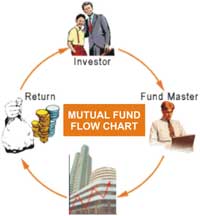
| The flow chart below describes
broadly the working of a mutual fund: |
| |
| How does a Mutual fund work? |
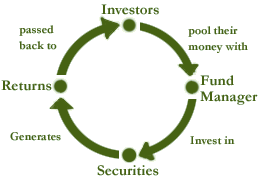
| A mutual fund is a collection
of stocks, bonds, or other securities owned by a group of investors
and managed by a professional investment company. For an individual
investor to have a diversified portfolio is difficult. But he can
approach to such company and can invest into shares. Mutual funds
have become very popular since they make individual investors to
invest in equity and debt securities easy. When investors invest
a particular amount in mutual funds, he becomes the unit holder
of corresponding units. In turn, mutual funds invest unit holders
money in stocks, bonds or other securities that earn interest or
dividend. This money is distributed to unit holders. If the fund
gets money by selling some stocks at higher price the unit holders
also are liable to get capital gains. A mutual fund is quite simply
a collection of stocks, bonds, or other securities owned by a group
of investors and managed by a professional investment company.
Thus the mutual funds are not the depositing instrument that has
guarantee of getting certain amount but it is like any other securities
where the investor can have capital gains or loss. |
 |
 |
| Advantages of Mutual Fund |
Professional Management - The primary
advantage of funds (at least theoretically) is the professional
management of your money. Investors purchase funds because they
do not have the time or the expertise to manage their own portfolio.
A mutual fund is a relatively inexpensive way for a small investor
to get a full-time manager to make and monitor investments.
Diversification - By owning shares in a mutual fund
instead of owning individual stocks or bonds, your risk is
spread out. The idea behind diversification is to invest in
a large number of assets so that a loss in any particular investment
is minimized by gains in others. In other words, the more stocks
and bonds you own, the less any one of them can hurt you (think
about Enron). Large mutual funds typically own hundreds of
different stocks in many different industries. It wouldn't
be possible for an investor to build this kind of a portfolio
with a small amount of money.
Economies of Scale - Because a mutual fund buys and sells
large amounts of securities at a time, its transaction costs
are lower than you as an individual would pay.
Liquidity - Just like an individual stock, a mutual fund
allows you to request that your shares be converted into cash
at any time.
Simplicity - Buying a mutual fund is easy! Pretty well
any bank has its own line of mutual funds, and the minimum investment
is small. Most companies also have automatic purchase plans whereby
as little as Rs 1000 can be invested on a monthly basis. - |
|
| History of Mutual Fund in India |
- Pioneer of mutual fund is UTI in 1963.
- Actual growth started in 1987.
- The dramatic improvement through quality wise and quantity
wise.
- Main reason for its poor growth is new concept in the
country.
- Large sections of Indian investor are yet to be intellectual
with this concept.
- Hence the it is prime responsibility of all Mutual Fund
companies , to make the product correctly abreast of selling.
- There are four 4 phases according to the development of
sector
|
|
| First Phase 1964-1987 |
- 1964 to 1987: - Unit Trust of India (UTI) was established
on 1963 by an Act of Parliament.
- It was set up by the Reserve Bank of India and functioned
under the Regulatory and administrative control of the Reserve
Bank of India.
- In 1978 UTI was de-linked from the RBI and the Industrial
Development Bank of India (IDBI) took over the regulatory
and administrative control in place of RBI.
- The first scheme launched by UTI was Unit Scheme 1964.
At the end of 1988 UTI had Rs.6,700 cores of asset
|
| Second Phase –
1987-1993 (Entry of Public Sector Funds) |
- 1987 marked the entry of non- UTI, public sector mutual funds
set up by public sector banks and Life Insurance Corporation
of India (LIC) and General Insurance Corporation of India (GIC).
- SBI Mutual Fund was the first non- UTI Mutual Fund established
in June 1987 followed by Canbank Mutual Fund (Dec 87), Punjab
National Bank Mutual Fund (Aug 89), Indian Bank Mutual Fund
(Nov 89), Bank of India (Jun 90), Bank of Baroda Mutual Fund
(Oct 92).
- LIC established its mutual fund in June 1989 while GIC
had set up its mutual fund in December 1990.
- At the end of 1993, the mutual fund industry had assets
under management of Rs.47,004 crores.
|
|
| Third Phase –
1993-2003 (Entry of Private Sector Funds)
|
- With the entry of private sector funds in 1993, a new era
started in the Indian mutual fund industry, giving the Indian
investors a wider choice of fund families. Also, 1993 was the
year in which the first Mutual Fund Regulations came into being,
under which all mutual funds, except UTI were to be registered
and governed.
- The erstwhile Kothari Pioneer (now merged with Franklin Templeton)
was the first private sector mutual fund registered in July 1993.
- The 1993 SEBI (Mutual Fund) Regulations were substituted by
a more comprehensive and revised Mutual Fund Regulations in 1996.
The industry now functions under the SEBI (Mutual Fund) Regulations
1996.
- The number of mutual fund houses went on increasing, with many
foreign mutual funds setting up funds in India and also the industry
has witnessed several mergers and acquisitions.
- As at the end of January 2003, there were 33 mutual funds with
total assets of Rs. 1,21,805 crores.
- The Unit Trust of India with Rs.44,541 crores of assets under
management was way ahead of other mutual funds.
|
|
| Fourth Phase – since February 2003 |
- In February 2003, following the repeal of the Unit
Trust of India Act 1963 UTI was bifurcated into two separate
entities. One is the Specified Undertaking of the
Unit Trust of India with assets under management of Rs.29,835
crores as at the end of January 2003, representing broadly,
the assets of US 64 scheme, assured return and certain other
schemes.
- The Specified Undertaking of Unit Trust of India, functioning
under an administrator and under the rules framed by Government
of India and does not come under the purview of the Mutual Fund
Regulations.
- The second is the UTI Mutual Fund Ltd, sponsored by SBI, PNB,
BOB and LIC. It is registered with SEBI and functions under the
Mutual Fund Regulations
- With the bifurcation of the erstwhile UTI which had in March
2000 more than Rs.76,000 crores of assets under management and
with the setting up of a UTI Mutual Fund, conforming to the SEBI
Mutual Fund Regulations, and with recent mergers taking place
among different private sector funds, the mutual fund industry
has entered its current phase of consolidation and growth.
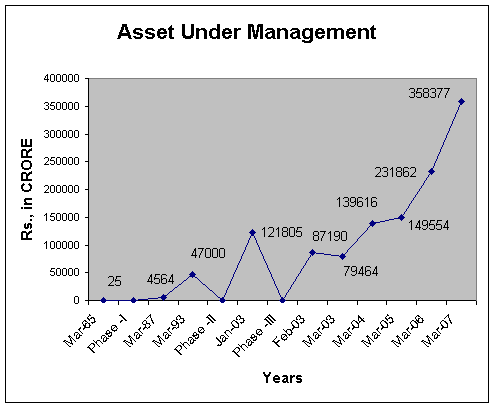
The graph indicates the growth of assets over the years.
|
|
| Growth in Asset Under Management |
 |
| |
| Regulations |
| Mutual Funds in India are governed by the SEBI
(Mutual Fund) Regulations 1996 as amended from
time to time. For further details please visit the SEBI website http://www.sebi.gov.in |
| |
| Organization of Mutual Fund |
|
| |
|
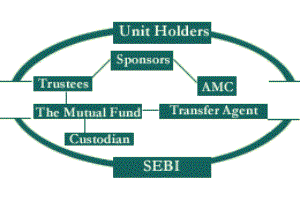
| The structure consists of |
Sponsor is the person who acting alone or in combination with another
body corporate establishes a mutual fund. Sponsor must contribute
at least 40% of the net worth of the Investment Managed and meet
the eligibility criteria prescribed under the Securities and Exchange
Board of India (Mutual Funds) Regulations, 1996.The Sponsor is
not responsible or liable for any loss or shortfall resulting from
the operation of the Schemes beyond the initial contribution made
by it towards setting up of the Mutual Fund.
The Mutual Fund is constituted as a trust in accordance with
the provisions of the Indian Trusts Act, 1882 by the Sponsor.
The trust deed is registered under the Indian Registration
Act, 1908.
Trustee is usually a company (corporate body) or a Board of Trustees
(body of individuals). The main responsibility of the Trustee
is to safeguard the interest of the unit holders and inter
alias ensure that the AMC functions in the interest of investors
and in accordance with the Securities and Exchange Board of
India (Mutual Funds) Regulations, 1996, the provisions of the
Trust Deed and the Offer Documents of the respective Schemes.
At least 2/3rd directors of the Trustee are independent directors
who are not associated with the Sponsor in any manner.
The Trustee as the Investment Manager of the Mutual Fund appoints
the AMC. The AMC is required to be approved by the Securities
and Exchange Board of India (SEBI) to act as an asset management
company of the Mutual Fund. Atlas 50% of the directors of the
AMC is an independent director who is not associated with the
Sponsor in any manner. The AMC must have a net worth of at
least 10 crore at all times.
The AMC if so authorized by the Trust Deed appoints the Registrar
and Transfer Agent to the Mutual Fund. The Registrar processes
the application form; redemption requests and dispatches account
statements to the unit holders. The Registrar and Transfer
agent also handles communications with investors and updates
investor records. |
| |
|
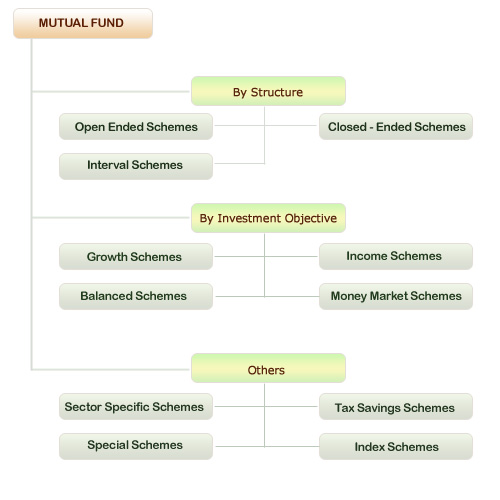
| Types of Mutual Fund |
|
Equity Oriented Schemes
These schemes, also commonly called Growth Schemes, seek to invest
a majority of their funds in equities and a small portion in money
market instruments. Such schemes have the potential to deliver
superior returns over the long term. However, because they invest
in equities, these schemes are exposed to fluctuations in value
especially in the short term.
Equity schemes are hence not suitable for investors seeking regular
income or needing to use their investments in the short-term. They
are ideal for investors who have a long-term investment horizon.
The NAV prices of equity fund fluctuates with market value of the
underlying stock which are influenced by external factors such
as social, political as well as economic. |
| |
Index Schemes
Index Funds replicate the portfolio of a particular index such
as the BSE Sensitive index, S&P NSE 50 index (Nifty), etc
These schemes invest in the securities in the same weight age
comprising of an index. NAVs of such schemes would rise or fall
in accordance with the rise or fall in the index, though not
exactly by the same percentage due to some factors known as "tracking
error" in technical terms. Necessary disclosures in this
regard are made in the offer document of the mutual fund scheme.
There are also exchange traded index funds launched by the mutual
funds, which are traded on the stock exchanges. |
| |
Sector Specific Schemes
These are the funds/schemes, which invest in the securities of
only those sectors or industries as specified in the offer documents.
e.g. Pharmaceuticals, Software, Fast Moving Consumer Goods (FMCG),
Petroleum stocks, etc. The returns in these funds are dependent
on the performance of the respective sectors/industries. While
these funds may give higher returns, they are more risky compared
to diversified funds. Investors need to keep a watch on the performance
of those sectors/industries and must exit at an appropriate time.
They may also seek advice of an expert.
|
| |
Tax Saving Schemes
These schemes offer tax rebates to the investors under specific
provisions of the Income Tax Act, 1961 as the Government offers
tax incentives for investment in specified avenues. e.g. Equity
Linked Savings Schemes (ELSS). Pension schemes launched by the
mutual funds also offer tax benefits. These schemes are growth
oriented and invest pre-dominantly in equities. Their growth
opportunities and risks associated are like any equity-oriented
scheme.
|
| |
Income/Debt Oriented
Scheme
The aim of income funds is to provide regular and steady income
to investors. Such schemes generally invest in fixed income securities
such as bonds, corporate debentures, Government securities and
money market instruments. Such funds are less risky compared to
equity schemes. These funds are not affected because of fluctuations
in equity markets. However, opportunities of capital appreciation
are also limited in such funds. The NAVs of such funds are affected
because of change in interest rates in the country. If the interest
rates fall, NAVs of such funds are likely to increase in the short
run and vice versa. However, long term investors may not bother
about these fluctuations.
|
| |
Hybrid/Balanced
Schemes
These schemes are commonly known as balanced schemes. These schemes
invest in both equities as well as debt. By investing in a mix
of this nature, balanced schemes seek to attain the objective of
income and moderate capital appreciation and are ideal for investors
with a conservative, long-term orientation. Balanced Fund and Gift
Fund are examples of hybrid schemes. |
| |
Money Market/Liquid Schemes
These funds are also income funds and their aim is to provide easy
liquidity, preservation of capital and moderate income. These schemes
invest exclusively in safer short-term instruments such as treasury
bills, certificates of deposit, commercial paper and inter-bank
call money, government securities, etc. Returns on these schemes
fluctuate much less compared to other funds. These funds are appropriate
for corporate and individual investors as a means to park their
surplus funds for short periods.
|
| |
Gilt Schemes
These funds invest exclusively in government securities. Government
securities have no default risk. NAVs of these schemes also fluctuate
due to change in interest rates and other economic factors as
are the case with income or debt oriented schemes. |
| |
Arbitrage Fund
Arbitrage is one of the most effective ways to insulate against
market volatility. An arbitrage fund buys equities in the cash
market and simultaneously sells in the futures market, thus ensuring
market neutrality for the investment. In
other words, it is a unique asset class by itself where returns
are generated by capturing the pricing differential between the
cash and the futures markets. It is also termed as a market-neutral
fund where the returns are not going to be impacted by volatility
in the market.
For any arbitrage fund, the following market conditions are beneficial -- a bullish market and a volatile
market. While the
fund performs very well in bullish markets, a volatile market gives
it opportunities for early exit, thus enhancing the overall yield
of the portfolio. However, a prolonged bear phase is not an ideal
situation for this kind of product. |
| |
Difference between Arbitrage
Fund & Income Fund both in terms of risk and returns
In terms of returns, an arbitrage fund is better than an income
product. An income product has a fixed yield-to-maturity while
in an arbitrage product, the yields are better due to lower cost
of carry and are usually in the range of 10-14%.
Secondly, the risk parameters are similar or lower than an income
product. An arbitrage fund does not
carry any credit rating risk and interest rate risk, while the
returns can be much higher than an income product. Added to this,
a mutual fund arbitrage product enjoys all the tax benefits enjoyed
by mutual fund products
Derivatives in India have more often been used for speculation
purposes than for hedging and arbitrage. What are your views on
this?
Both in India and the world over, derivatives have been widely
used as a leverage product but as the trends are changing and the
investors are maturing, the other tools like hedging and risk free
arbitrage strategies are also being widely used. |
| |
Gold Exchange-Traded
Schemes
Exchange-traded funds (ETFs) are mutual fund schemes that are listed
and traded on exchanges like stocks. ETFs trading value is based
on the net asset value (NAV) of the assets it represents. Generally,
ETFs invest in a basket of stocks and try to replicate a stock
market index such as the S&P CNX Nifty or BSE Sensex, a market
sector such as energy or technology, or a commodity such as gold
or petroleum.
Recently, the Securities and Exchange Board of India (SEBI) amended
its regulations and allowed mutual funds launch gold exchange-traded
funds (GETFs) in India. Two mutual funds, UTI mutual fund and Benchmark
Mutual Fund, has been launched. These funds got listed on
the National Stock Exchange (NSE).
A gold-exchange traded fund unit is like a mutual fund unit backed
by gold as the underlying asset and would be held mostly in demat
form. An investor would get a securities certificate issued by
the mutual fund running the Gold-ETF defining the ownership of
a particular amount of gold. GETFs are designed to offer investors
a means of participating in the gold bullion market without the
necessity of taking physical delivery of gold, and to buy and sell
through trading of a security on a stock exchange.
With gold being one of the important asset classes, GETFs will
provide a better, simpler and affordable method of investing as
compared to other investment methods like bullion, gold coins,
gold futures, or jewelry.
|
Maturity Plans (FMPs)
Safe, predictable and better post-tax returns than bank FDs
Rising interest rates not only mean rising EMIs but also offer
an opportunity to earn higher returns. Debt schemes are now offering
attractive returns with short-term rates in the region of 8-10%.
Call money rates have been moving higher to about 7.5-8% due to
tight liquidity conditions. With the RBI deciding to raise the
cash reserve ratio (CRR), liquidity conditions have worsened. Tightness
in the money markets is expected to continue till the end of the
current financial year and investors can consider investing in
short term options like FMPs or floating rate schemes. Fixed
maturity plans, or FMPs as they are popularly called, are close-ended
funds with a fixed tenure and invest in a portfolio of debt products
whose maturity coincides with the maturity of the product.
The primary objective of a FMP is to generate income while protecting
the capital by investing in a portfolio of debt and money market
securities. The tenure can be of different maturities, ranging
from one month to five years.
FMPs can be compared to fixed deposits of a bank. While a fixed
deposit offers a 'guaranteed' return, returns in FMPs are only
'indicative'. Typically, the fund house fixes a 'target amount'
for a scheme, which it ties up informally with borrowers before
the scheme opens. That way it knows the interest rate it will earn
on its investments, providing the 'indicative return' to investors. |
| |
Monthly Income Plans
Monthly income plans, or MIPs, as they are more popularly known,
are a category of mutual funds that invest mainly in debt instruments.
Only about 10-20-% of the assets are allocated to equity
stocks. But the very name – monthly
income plan – is a misnomer, as these funds do not guarantee
a monthly income. Like any other fund, the returns are market-driven.
Though many fund houses strive to declare a monthly dividend, they
have no such obligation. MIPs are launched with the objective of
giving a monthly income to investors, but the periodicity depends
upon the option chosen by the investor. These are generally monthly,
quarterly, half-yearly and annual options. A growth option is also
available, where the investors do not receive regular dividends,
but gains in the form of capital appreciation. |
|
|